
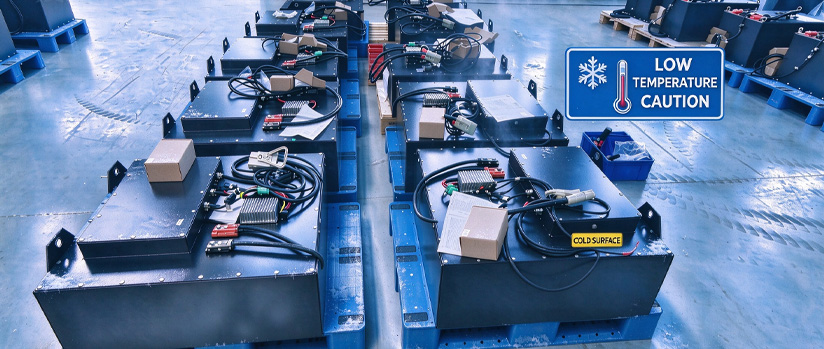
Forklift batteries lose usable capacity in cold weather because low temperatures slow electrochemical reactions and increase internal resistance. As a result, a battery that comfortably powers a forklift through a full shift in summer may struggle to deliver the same runtime in winter.In this guide, we explain why forklift battery performance declines in winter, compare lead-acid and lithium technologies, and share seven practical ways to protect battery performance in cold-weather operations.
Low temperatures slow the chemical reactions involved in charging and discharging a battery.
In flooded lead-acid batteries, lower temperatures affect the behavior of the sulfuric acid electrolyte and the reactions occurring at the battery plates. In LiFePO4 batteries, reduced temperatures slow lithium-ion movement and charge-transfer processes within the cells.
The result is reduced power availability and, depending on operating conditions, less usable energy during a shift.
Cold temperatures generally increase battery internal resistance. When a forklift accelerates, lifts a load, or climbs a ramp, the battery must deliver a high current.
Higher resistance can cause a larger voltage drop under load. A battery may appear fully charged but still struggle to meet the forklift's power demands in cold conditions.
Cold weather also affects charging.
Lead-acid batteries may accept charge less efficiently at low temperatures. If the charging process is not adjusted appropriately, repeated incomplete charging can contribute to sulfation and long-term capacity loss.
LiFePO4 batteries have a different limitation. Charging lithium cells below their specified minimum temperature can cause lithium plating on the anode, potentially resulting in permanent capacity loss and safety risks.
For this reason, low-temperature charging restrictions must be treated separately from low-temperature discharge capability.
Important: Always follow the battery manufacturer's specified charging and discharging temperature limits. A battery that can discharge below 0°C (32°F) is not necessarily permitted to charge at the same temperature.
| Factor | Flooded Lead-Acid | LiFePO4 Lithium |
|---|---|---|
| Available capacity | Generally decreases as temperature falls | Generally decreases as temperature falls |
| Voltage under load | Voltage drop can become more noticeable | Often maintains a relatively flat discharge voltage before the low-voltage limit |
| Cold-weather charging | Requires appropriate charging procedures and temperature considerations | Must remain within the cell's permitted charging temperature |
| Low-temperature charging protection | Depends on charger, battery design, and monitoring | May include BMS temperature protection and integrated heating |
| Routine maintenance | May require electrolyte checks and specific-gravity testing | Usually requires less routine cell maintenance |
| Opportunity charging | Must follow battery and charger requirements | Often supported when permitted by the battery manufacturer |
| Cold-storage suitability | Depends on temperature, charging arrangements, and duty cycle | Depends on low-temperature specifications and heating provisions |
Actual performance varies by battery design, age, discharge rate, state of charge, and operating conditions. Neither chemistry should be selected on the basis of temperature alone.
When evaluating a battery for winter use, check the manufacturer's discharge curves and test data at temperatures and discharge rates closest to your actual application.
Do not assume that a battery rated for a particular amp-hour capacity at room temperature will deliver the same usable energy in a cold warehouse.
For a meaningful comparison, evaluate:
Rated capacity and test conditions.
Minimum and maximum operating temperatures.
Continuous and peak discharge current.
Minimum discharge voltage and protection settings.
Whether the battery has integrated heating.
Energy consumed by heating during cold-weather operation.
These factors provide a more reliable basis for estimating winter runtime than a generic capacity-retention percentage.
LiFePO4 batteries offer several operational advantages, including relatively stable discharge voltage, lower routine maintenance requirements, and the potential for opportunity charging.
For cold-storage applications, some industrial lithium battery packs also incorporate heating systems controlled by the battery management system (BMS). These systems can warm the cells before charging when the battery temperature is below the permitted charging range.
However, heating does not automatically guarantee a particular capacity-retention percentage or eliminate all cold-weather limitations. Heating energy consumption, warm-up time, insulation, cell specifications, and charging arrangements all affect real-world performance.
For demanding freezer applications, request documented low-temperature discharge and charging specifications from the battery supplier before making a purchasing decision.
The following practices can help fleet managers reduce cold-related downtime and maintain battery performance.
Recharge lead-acid batteries according to the manufacturer's instructions and avoid prolonged storage at a low state of charge.
For lithium batteries, follow the approved charging schedule and BMS requirements. Do not assume that charging immediately after every shift is suitable for every battery or operating environment.
Where practical, charge batteries in an environment that meets the manufacturer's recommended temperature range.
For lithium batteries, confirm that the cell temperature is within the permitted charging range. If the battery uses integrated heating, verify that the heating function and charging interlocks operate as intended.
Never bypass low-temperature charging protection.
Check that the charger matches the battery chemistry, nominal voltage, capacity, charging current, and connector configuration.
For lead-acid batteries, determine whether temperature compensation is required or supported by the battery manufacturer.
For lithium batteries, confirm compatibility with the battery's charging profile and BMS requirements.
A correctly matched charger helps reduce charging problems and supports long-term battery performance.
Cold weather can make existing battery weaknesses more noticeable.
Inspect terminals, cables, connectors, and accessible battery components according to the manufacturer's maintenance schedule.
For serviceable flooded lead-acid batteries, check electrolyte levels and specific gravity when required by the manufacturer and permitted by the battery design.
Do not open sealed or maintenance-free batteries. Lithium battery diagnostics should follow the manufacturer's approved procedures.
Review how long each forklift operates, when it can recharge, and whether it experiences long periods of high-current demand.
LiFePO4 batteries may support opportunity charging during breaks if the battery manufacturer permits it. This can improve equipment availability when charging infrastructure and shift schedules are designed appropriately.
Lead-acid batteries have different charging and recovery requirements, so their charging routines should not automatically follow lithium operating practices.
A battery that provides sufficient runtime in summer may not meet the same duty cycle in winter.
When sizing a replacement battery, consider:
Forklift model and battery compartment dimensions.
Required voltage and available capacity.
Typical load weight and lifting frequency.
Daily operating hours and shift pattern.
Ambient and battery operating temperatures.
Charging opportunities and required reserve capacity.
Using actual operating data helps prevent undersizing and reduces the likelihood of unexpected mid-shift shutdowns.
For refrigerated warehouses and freezer operations, compare conventional lead-acid systems with lithium batteries specifically designed for low-temperature applications.
A suitable heated lithium system may improve charging flexibility and reduce the need for battery changes, depending on the operating schedule and charging infrastructure.
Before selecting a system, confirm its minimum discharge temperature, minimum charging temperature, heating power consumption, warm-up time, and performance under the expected workload.
The best choice depends on total operating cost, not battery purchase price alone.
Selecting the right battery and charger for cold-weather operations requires more than matching nominal voltage. Battery temperature limits, operating hours, charging arrangements, and forklift compatibility all affect the final configuration.
LIFTTOP supplies forklift and pallet truck parts for equipment from major brands, including Toyota, Linde, Komatsu, Mitsubishi, EP, Hangcha, Heli, and Noblelift. Our product range includes electrical components, battery chargers, and other replacement parts, with OEM/ODM support for suitable customization requirements.
Whether you are maintaining an existing fleet or evaluating a new battery configuration, our team can help identify relevant parts and compatibility requirements.
Request a Forklift Battery and Charger
Send us your forklift model, battery specifications, operating temperature, or existing part numbers. Our team can help you identify suitable products and prepare a quotation based on your requirements.
Battery performance figures and operating limits vary by manufacturer, cell design, battery age, discharge rate, and test conditions. Always consult the relevant battery and charger datasheets before selecting equipment or changing charging procedures. This article provides general guidance and does not replace manufacturer instructions or a qualified technical assessment.
Obtenha as últimas ofertas da HUAN XIN Mecânica e Elétrica


Envie-nos um e-mail
E-mail : simon@lifttops.com
Endereço


 IPv6 rede suportada


 português
 português
 English
 français
 русский
 español
 العربية

